
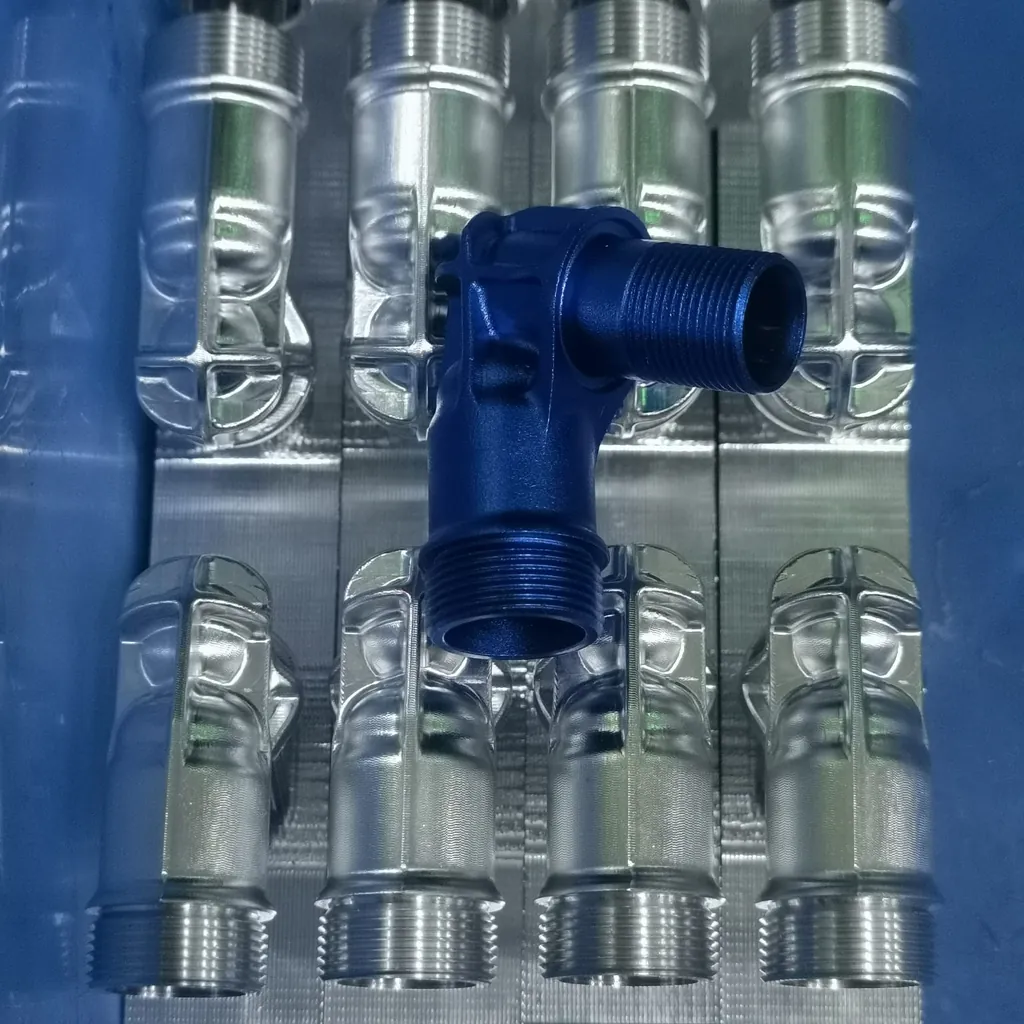
6061 and 7075 are the two aluminum alloys that appear most often in CNC machining quotes. They look the same on a drawing — “AL 6061” versus “AL 7075” — but they machine differently, finish differently and cost differently. The right choice depends on what the part has to survive, not on which alloy is “better”.
Quick answer
Use 6061-T6 for most machined parts: housings, brackets, fixtures, plates, fittings, and anything that will be welded or anodized in a cosmetic color. Use 7075-T6 when strength or stiffness per kilogram is the constraint — aerospace components, thin-wall structures, high-load tooling and parts that cannot grow in section. If the part is not strength-critical, 6061 is almost always the cheaper and more forgiving answer.
Composition and properties
| Property | 6061-T6 | 7075-T6 |
|---|---|---|
| Alloy family | Al-Mg-Si | Al-Zn-Mg-Cu |
| Magnesium | ~1.0% | ~2.5% |
| Zinc | — | ~5.6% |
| Copper | ~0.28% | ~1.6% |
| Tensile strength | ~310 MPa | ~572 MPa |
| Yield strength | ~276 MPa | ~503 MPa |
| Elongation | ~12% | ~11% |
| Hardness | ~95 HB | ~150 HB |
| Machinability | Good | Very good |
| Weldability | Good | Poor |
| Corrosion resistance | Good | Moderate |
| Anodizing | Clean, predictable color | Hard anodize preferred; color can shift |
| Relative material cost | Lower | Higher |
Strength without the weight
7075-T6 is roughly 80% stronger than 6061-T6 in yield. That does not automatically make it the right alloy: it is more notch-sensitive, has lower fracture toughness, and cannot be welded. But when a bracket has to carry a load in a 2 mm wall, the difference between 276 and 503 MPa is the difference between a part that works and one that does not.
For a stiffness-limited part, alloy choice matters less than geometry. Young’s modulus is nearly the same for both alloys — about 69 GPa. If the part deflects because it is thin, switching from 6061 to 7075 will not fix it unless you are already at the yield limit. Adding a rib or increasing section usually does more.
Corrosion, anodizing and finish
6061 is the easier alloy to finish. It anodizes to a clean, consistent color — clear, black, blue, red — and takes Type II anodizing well. 7075 contains copper and zinc; its anodic layer tends to be darker and less uniform, so cosmetic color matching is harder. For 7075, Type III hard anodizing is common because it adds wear resistance and the color variation matters less.
If the part lives outdoors, near salt water or in a wash-down environment, 6061 with a proper anodized or painted finish is usually the safer choice. 7075 in some tempers is more sensitive to stress-corrosion cracking under sustained load in a corrosive environment. That is a design conversation, but it belongs in the material decision.
When 6061 is the right choice
- Enclosures, plates, brackets, mounts and fixtures that carry normal loads
- Parts that will be welded to a frame or another component
- Cosmetic anodized parts where color consistency matters
- Marine, outdoor and wash-down environments
- Prototypes where material availability and cost matter
- Anything where the design is still changing — 6061 is cheaper to re-cut
When 7075 is the right choice
- Aerospace and drone structures where strength-to-weight drives the design
- Thin-wall housings and long unsupported spans
- High-load tooling, jaws, clamps and wear parts
- Bicycle, motorsport and RC components
- Parts that must resist deformation under a point load
- Applications where hard anodizing is specified anyway
Other aluminum grades worth knowing
- 6082-T6 — the European near-equivalent of 6061: slightly higher strength, similar machining and anodizing behaviour, and often the default when the supply chain is in Europe.
- 2024-T4 / T351 — higher strength than 6061 with poor corrosion resistance; usually clad or coated and common in aerospace where fatigue matters.
- 5052-H32 — excellent corrosion resistance and formability at lower strength; good for sheet-metal covers and brackets, not the first choice for heavy machining.
- 5083 — marine-grade plate with good corrosion resistance and weldability, used for structural parts that see salt water.
- 7050 — a higher-strength aerospace grade with tighter property control and a higher price than 7075.
How to specify aluminum in an RFQ
A one-line material callout is not enough for an accurate quote. Include:
- Alloy and temper, e.g. 6061-T651 plate — not just “6061”
- Product form if it matters: plate, extrusion or bar
- Finish: as-machined, bead blast, Type II anodize (color), Type III hard anodize, chem film or paint
- Critical surfaces or features that must not be machined after finishing
- Quantity, and whether the part will repeat
The temper matters more than most drawings suggest: 6061-T6 bar and 6061-T651 plate machine and behave differently, and 7075-T6 and 7075-T651 are not interchangeable in every application.
Frequently asked questions
Is 7075 stronger than 6061?
Yes. In the T6 temper, 7075 has roughly 572 MPa tensile strength and 503 MPa yield strength, against about 310 MPa tensile and 276 MPa yield for 6061-T6. That is roughly 80% higher yield strength — but 7075 is also more notch-sensitive and less weldable.
Can 7075 aluminum be anodized?
It can, but the copper and zinc in the alloy make the anodic layer darker and less uniform, so cosmetic color matching is harder. Type III hard anodizing is common on 7075 because wear resistance matters more than perfect color. For clean, consistent clear or black cosmetic finishes, 6061 is the safer choice.
Which alloy is easier to machine, 6061 or 7075?
Both machine well. 7075 is stronger and can support faster cutting in some operations, but it is more notch-sensitive and less forgiving of a sharp internal corner. 6061 is the safer default for prototypes and general parts, and it is easier to source.
Is 7075 suitable for marine or outdoor use?
Not uncoated. 6061 and 5083 resist salt water much better. If a part needs 7075’s strength in a corrosive environment, specify a protective finish and review stress-corrosion behaviour with the load case in hand.
Not sure which alloy your part needs?
Send the drawing with the load case and the environment. We will recommend an alloy and a temper — and tell you if the cheaper one will do the job.
Or email yueli@promachiningtech.com · WhatsApp +86 152 9880 5789